Build and grow the revenue you control — the system for stable, scalable, controllable growth.
Core idea: Margin and control are functions of proximity. The further you are from the customer, the more margin you surrender and the less control you keep. Affiliates and resellers can extend reach and scale—but they always tax your economics.
A Quick Look at Revenue Pathways:
- Proximity Principle: The closer you are to the buyer, the higher your margin and the tighter your control.
- The Hidden Cost of Avoidance: Every day without direct contact with customers is a day of 0% revenue from those customers.
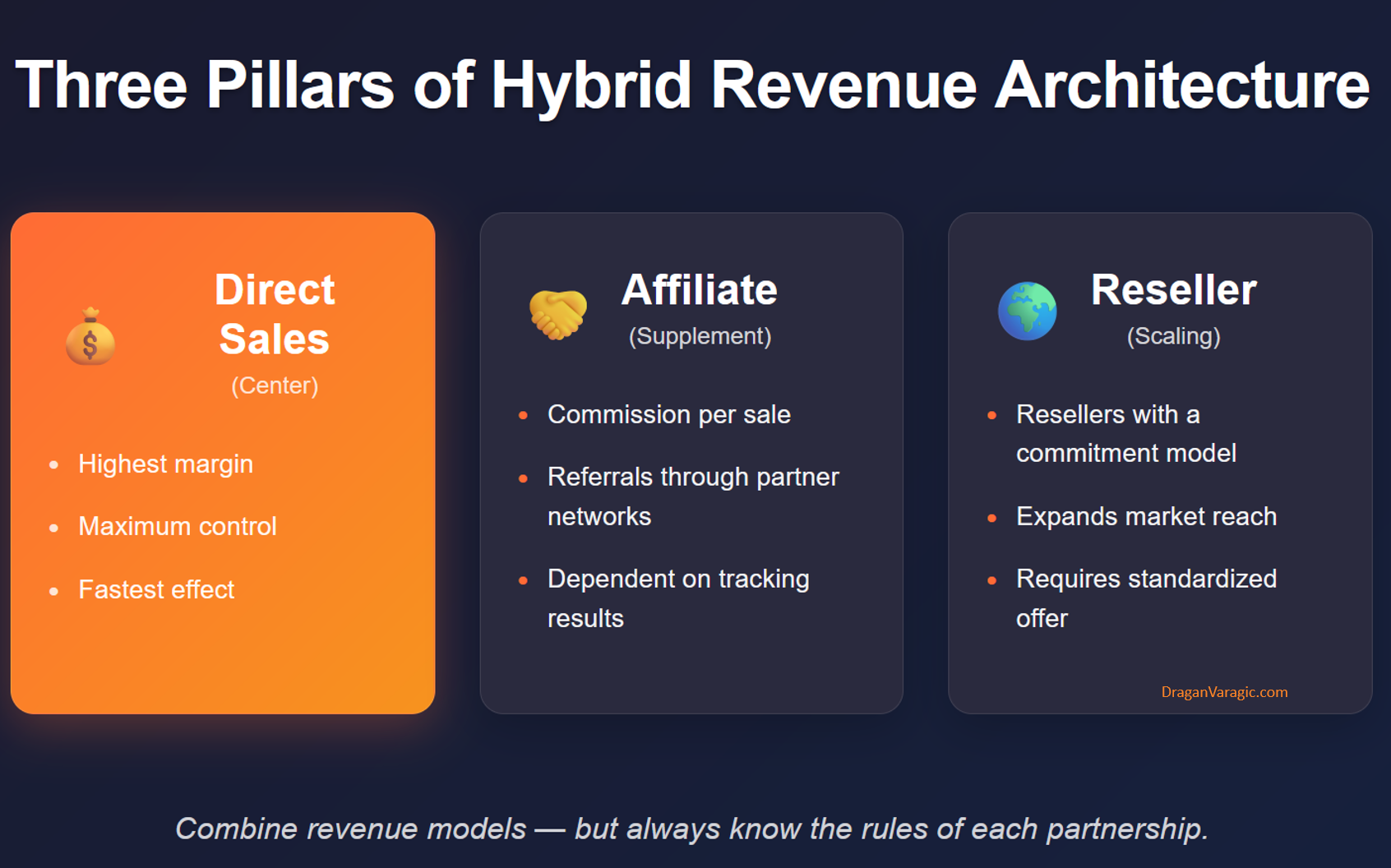
- The Hybrid Play (on purpose, not by accident): Make Direct Sales the center; add Affiliates for reach and Resellers for scale—each with clear rules and commitments.
Why this matters now
Most “growth problems” are architecture problems. If you rely on one channel, you inherit its limits. If you outsource the sale, you outsource the margin. If you avoid direct conversations, you avoid the feedback that makes offers sharp and sellable.
What this article delivers
A practical system to design revenue intentionally: lead with direct sales, use partners where they add net value, and enforce commitments so every channel earns its place.
Lead the sale. Let partners extend it. Never abdicate it.
What is Hybrid Revenue Architecture?
Every business revenue stream ultimately comes from just three models:
1. Direct Sales – You sell directly to the customer. You keep full control and 100% of the margin.
Example: A trainer sells a course for €500 and keeps all the revenue.
2. Affiliate Model (Commission-Based Sales) – A partner brings you customers and earns a cut of the transaction. You lose some margin, but gain reach.
Example: A partner promotes the course with a tracked link, earns €100 commission (20%), while the trainer keeps €400.
3. Reseller Model (Buy & Resell) – Another company buys your offer at a discount and resells it. You give up the most control, but open access to new markets.
Example: An agency resells the same course with a 40% margin; the trainer earns €300 per sale.
Key principle: Don’t bet everything on a single channel.
The most resilient strategy is a hybrid system—direct sales at the center, with affiliates and resellers as structured extensions.
This way, no single channel dictates your growth.
Critical Precondition – Can Your Offer Actually Sell?
All these models work only if your offer has real value for customers – value they recognize through purchasing.
If your offer doesn’t matter to the end buyer, it won’t matter to partners either. Value cannot be skipped – it’s the ticket into all revenue models.
Partners want to recommend or resell something that customers already perceive as valuable and are buying – because only then do they also earn.
That’s why the first step is always: make sure your offer solves a real customer problem.
Only then does Hybrid Revenue Architecture become a strong system.
When the Model Isn’t Defined – Free Work on a Promise
The most expensive service you can provide is the one you never get paid for. And this happens almost every time you work based on a promise.
Imagine this situation:
A company calls you and says – “Run a training for our team, and in return we’ll give you contacts and help sell your services further.”
You agree.
You spend hours preparing and delivering. The team is satisfied.
And then – silence.
No contacts, no sales, no “next steps.”
What happened?
Instead of clearly defining which revenue model you’re working under, you remained in the zone of “handshake deals and promises.”
Result = work done, revenue zero.
Recommendation: Always send every potential partner a pre-prepared partner offer.
Contact me if you’d like my FREE Guide for Resellers and Affiliate Partners, which solves this issue and defines partnership relationships clearly.
Rule of Revenue Proximity – Why Direct Sales Are Always Recommended
The closer you are to direct sales, the more you earn. This is one of the simplest and most important rules.
Every time you take a step away from direct sales, you’re giving away part of your revenue to someone else. That’s the most expensive cost of convenience.
Example:
- If a trainer sells a course directly for €500 – they keep the full €500.
- If sold through an affiliate partner with 20% commission – they keep €400.
- If sold through a reseller with a 40% margin – they keep €300.
Lesson: The closer you are to the customer, the higher your margin.
Direct sales should always be your revenue center.
Affiliate and reseller models are excellent for expansion and support – but they should never replace direct customer relationships.
Example: Using Google AdSense Advertising Program
Many digital media owners, bloggers, and YouTubers rely only on Google AdSense, where they earn just a few euros per thousands of views.
What are we to Google when we use AdSense?
We are space resellers – we give our digital space (website, blog, video, portal) to Google, and Google resells it to advertisers.
What is Google AdSense to us?
It’s an affiliate-like revenue model (a commission).
Those who create their own digital products – courses, e-books, subscriptions, AI products – earn many times more, even with a smaller audience.
Why Avoiding Direct Sales Is Not the Answer
Many individuals and companies try to avoid direct sales, hoping to “skip it” through recommendations, affiliates, and resellers.
The problem is that this almost always means lower revenues and less control over how revenue comes in.
Direct sales don’t have to be aggressive or uncomfortable.
It’s enough to:
- Create a list of 5 potential buyers you already know.
- Send them a simple 3–4 sentence message (what you offer, why it’s valuable, what the next step is).
- Schedule a conversation – that’s the beginning.
Practical lesson: Direct sales are just a conversation where you offer value. Once you start small, resistance fades – and results come much faster than you expect.
How to Choose Your Dominant Revenue Model – Mini Framework
Once you know there are three revenue models (direct sales, affiliate, reseller), the key question is: Which one brings you the most right now?
Instead of complex matrices, just ask yourself three simple questions:
1. How fast do I need revenue?
- If the answer is “immediately” – focus on direct sales.
- Affiliate and reseller are slower because they depend on others.
2. What is my capacity for selling on my own?
- If you have little time or no sales team – add affiliate as support.
- If your product or service is well-defined and easily sold by others – bring in resellers.
3. How much control do I want over the brand and customers?
- If you want full control – direct sales are non-negotiable.
- If you’re ready for compromise in order to scale – add affiliate and reseller as support.
How to use this mini framework?
Answer these three questions honestly and mark:
- Your primary model (focus).
- Your secondary model (support).
Result: You get a clear roadmap for allocating energy and resources over the next 3 months.
How to Check the Quality of Affiliate and Reseller Partners
Partnerships can be a strong source of revenue – but only if partners actually do their part.
The biggest mistake: letting affiliates or resellers “just sit there” without measuring results.
A partnership without a clear goal is not a partnership, but an illusion.
The commitment model means: either we both earn – or we both know this isn’t a real partnership.
1. Checking affiliate partners
- Problem: Many sign up, but very few actually bring sales.
- Solution: Set a monthly minimum (e.g., at least 2 sales per month).
- If a partner doesn’t hit the minimum for 3 months ? pause or remove them from the program.
2. Checking reseller partners
- Problem: The reseller takes your offer, but doesn’t invest in active selling.
- Solution: Introduce a commitment model – the reseller must commit to a minimum volume (e.g., 10 licenses per quarter).
- They define their own sales plan.
Practical lesson:
Affiliate and reseller programs only work if there is tracking and commitment.
Without it – they turn into a list of names, not a source of revenue.
What Works Best for Service-Based Revenue?
In digital services niches*, the key difference in revenue often isn’t the number of clients, but the structure of your offer.
(*Especially in B2B – e.g., trainers, consultants, educators)
1. Premium (High-ticket) Offers
- Example: A consulting program priced at €5,000.
- Fewer clients needed to reach the same revenue.
- Ideal for direct sales, because the buyer wants direct communication and trust.
Pro tip: If you have knowledge that solves a big problem – package it as a “premium” program. That becomes a pillar of service stability.
2. Subscriptions and Membership Models
- Example: An educational platform at €200/month.
- Revenue becomes predictable and scalable.
- Perfectly combines with affiliate partners – it’s easier to promote a subscription than a one-off high price.
Pro tip: If you want stability and predictability – build a subscription.
3. Methodological Tools and AI Digital Products
- Examples: A premium template for partner discount structuring; an AI tool for packaging offers.
- Build once – sell unlimited times.
- Resellers love them, because they’re easy to sell and have low entry barriers for end customers.
Pro tip: If you want fast expansion through resellers – create standardized tools and digital products.
Key balance:
- Premium offers – highest profit per client.
- Subscriptions – stability and predictability.
- Digital (AI) products – scalability and revenue add-ons.
By combining all three, your income becomes more stable and diversified – and that’s the foundation of Hybrid Revenue Architecture.
How to Get Started Right Away – 3 Micro Tools
You don’t need to wait for a big plan.
It’s enough to take one small step in the right direction today.
1. Direct Sales – Today
- Make a list of 10 contacts.
- Send them a “5-sentence pitch.”
- Goal: start at least 2 conversations within the next 3 days.
If you don’t send a message today, you’ve lost 100% of your chance to earn from that customer.
Direct sales are the only step that opens doors immediately.
2. Affiliate – Next Week
- Select 3 people in your network who already have access to your audience.
- Offer them a simple commission (e.g., 20%).
- Start tracking real monthly sales.
3. Reseller – Next Month
- Identify a company/agency already working with your ideal clients.
- Offer them a model: at least 3 sales per month to keep their full margin.
- Give them a clear sales package (PDF with prices and outcomes).
If you follow this roadmap:
- Today – direct sales begin.
- Next week – affiliate network activated.
- Next month – reseller commitment introduced.
Within 30 days you’ll have 3 active revenue channels – and a clear picture of where your business is actually growing.
Conclusion: Three Channels, One Center
In the end, everything comes down to a simple formula:
- Direct sales – foundation and center of the system (highest margin, maximum control).
- Affiliate program – support channel, excellent for network expansion, but profitable only when tracking real monthly sales.
- Reseller network – scaling tool, profitable only when there’s commitment (clear agreement on minimum sales to keep the margin).
Direct sales are the heart of your revenue.
Affiliates are the arteries that extend your reach.
Resellers are the muscles that give strength.
But without the heart – everything else stops.
Next Steps – Tools and Resources
Contact me if you’d like tools that solve revenue challenges and define partner relationships across different dimensions:
- Free Guide for resellers and affiliate partners
- Professional Tools Offer – PRO Hybrid Revenue Architecture Toolkit
- Premium Personalized Documents – PREMIUM Hybrid Revenue Architecture Toolkit
Pro tip: Start with the Free Guide — then you’ll instantly see why the PRO and PREMIUM kits pay for themselves.
Final Word:
The most expensive thing isn’t investing in a premium tool – it’s spending 6 months without a clear strategy and losing dozens of revenue opportunities. A Premium Toolkit isn’t a luxury – it’s an accelerator that saves you from wasting both time and money.